
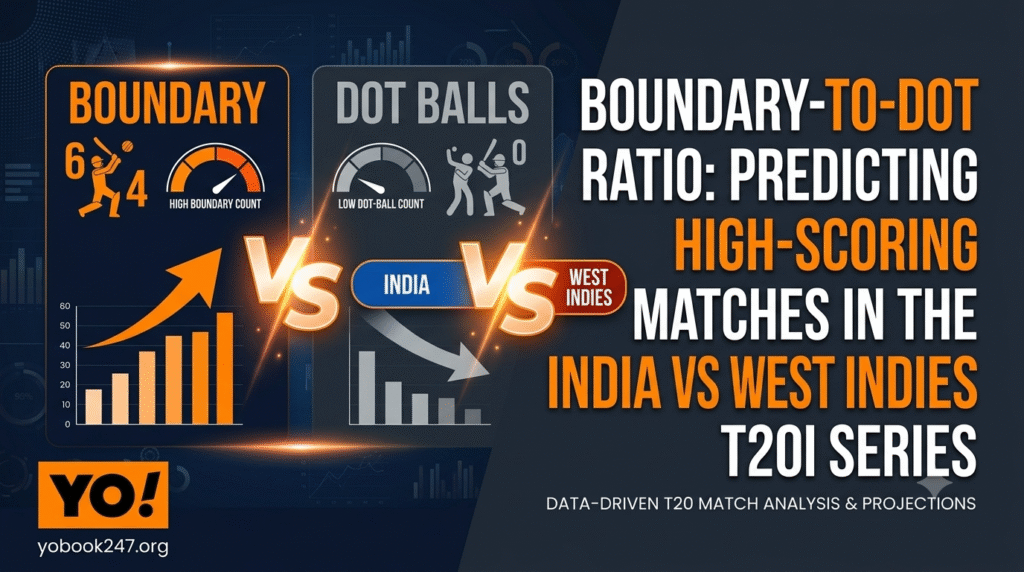
Yobook247– Average runs per over is the number everyone quotes, but it hides more than it reveals. Two teams can post identical run rates while scoring in completely different ways — one grinding out ones and twos with the occasional boundary, the other alternating dot balls with fours and sixes. The boundary-to-dot ball ratio captures that difference directly, and it’s a genuinely more useful signal ahead of the five-match India vs West Indies T20I series starting October 6 in Lucknow.
What the Ratio Actually Measures
The boundary-to-dot ratio divides the number of boundaries (fours and sixes) a team hits by the number of dot balls they play in an innings. A high ratio means a team is either finding the rope or getting nothing — an aggressive, high-variance scoring pattern. A low ratio suggests a team working the ball around for singles and twos, with fewer big hits but also fewer completely dead deliveries.
Why This Matters More Than Just an Average
Predicting high-scoring T20 matches using just an average run rate misses the shape of an innings entirely. A team with a boundary-heavy, high-dot-ball profile can post the same 180 as a team that ran hard between the wickets and rarely cleared the rope — but the two are genuinely different propositions for a bettor tracking a cricket betting ID account through a live match. The high-boundary team is more likely to have unpredictable, streaky innings; the low-dot team tends toward steadier, more consistent scoring patterns.
How to Read the Ratio Practically
A ratio above roughly 0.15-0.18 (one boundary for every 6-7 dot balls or fewer) typically signals an aggressive, boundary-reliant batting unit likely to produce high-variance totals.
A ratio closer to 0.08-0.10 suggests a rotation-focused batting line-up, generally producing more consistent totals with fewer explosive overs.
Track it by phase, not just for the full innings. A team’s powerplay ratio and death-overs ratio can look very different from their middle-overs number, and each phase tells a distinct part of the story.
Applying This to the India vs West Indies T20Is
A boundary-heavy line-up facing a bowling attack that concedes dot balls at a high rate is a genuinely different match-up than the same line-up against a side that limits boundaries but leaks ones and twos. Checking recent boundary-to-dot ratios for both India and West Indies heading into the October 6 series — not just their overall run rates — gives a clearer read on how each innings is actually likely to unfold, rather than just what the final total might be.
Why Boundary-Reliant Teams Carry More Variance
A high boundary-to-dot ratio isn’t automatically a stronger batting profile — it’s a higher-variance one.
A team that scores primarily through boundaries can just as easily have a quiet night if the big shots don’t come off, since there’s less of a base of ones and twos to fall back on. A rotation-heavy team’s scoring is more resilient to an off night for any single batter, even if its ceiling is generally lower.
The Bottom Line
Average runs per over tells you the destination, not the journey. The boundary-to-dot ratio tells you how bumpy that journey is likely to be — useful context for anyone tracking a match through a cricket betting ID rather than just glancing at a final score prediction. Heading into the India-West Indies T20I series, checking this ratio phase by phase gives a genuinely sharper read than the season average alone.
Frequently Asked Questions
What is a good boundary-to-dot ball ratio in T20 cricket?
There’s no single universal number, but a ratio above roughly 0.15 (one boundary for every six or seven dot balls) generally signals an aggressive, high-variance scoring approach.
Why is this ratio more useful than average run rate alone?
Because two teams can post the same average run rate through very different scoring patterns — one boundary-heavy and streaky, one steady and rotation-based — and the ratio reveals which is which.
Does a high boundary ratio always mean a stronger batting line-up?
Not necessarily. It often means a higher-variance one — capable of big totals but also more exposed to a quiet night if the big shots don’t land.
When do India and West Indies play their T20I series?
The five-match T20I series begins October 6, 2026, in Lucknow, following the conclusion of the three-match ODI series on October 3.
This article is for informational and educational purposes only and does not constitute betting advice. Schedule details are accurate as of publication and subject to change. Online betting involves financial risk. 18+ only. Please gamble responsibly.
